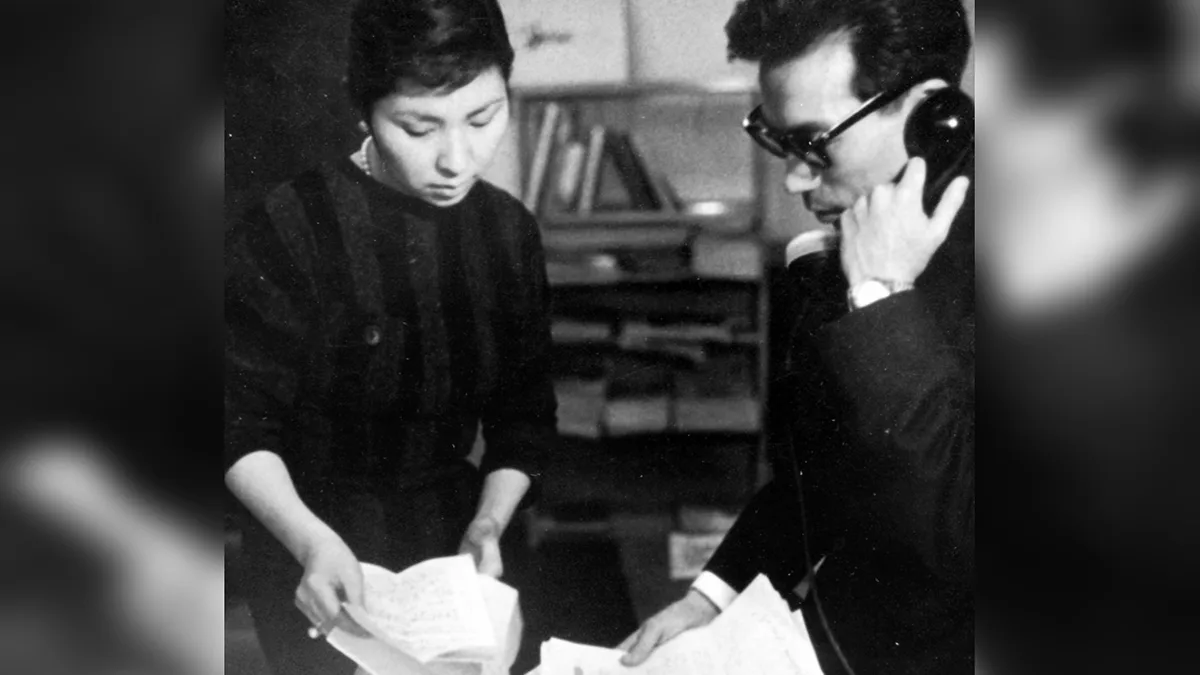
Since its founding in 1960, the company has promoted a diverse range of major Japanese companies representing the fields of steel, shipbuilding, architecture and healthcare. Today, COSMO continues to support communications frameworks for numerous global corporations and organizations. Here we highlight COSMO’s editorial work, one of our progressive business focus.
Influential Article on Environmental Preservation
The year 1964 saw the launch of the corporate quarterly magazine approach by Takenaka Corporation, a major architectural, engineering and construction company, with COSMO providing editorial services. approach continues to be published today, and while it is predominantly a Japanese-language magazine, it integrates English-language abstracts of articles and photo captions for English-speaking readers. Tsune Sesoko, one of the three co-founders of COSMO, placed her Three Smiles Principle1 at the center of its editorial policy. This principle entails bringing satisfaction to all three parties involved: client, creator (designers, photographers, writers, editors) and reader, with the intention of ultimately benefiting society. Then as now, each issue of approach features a special report on a single theme, such as architecture, urban planning, design, environment and education. Included are updates on the company’s recent architectural works and new technologies.
Influential graphic designer Ikko Tanaka2 had recently launched his own studio, and Sesoko appointed him as art director to approach. She also asked renowned photographer Yasuhiro Ishimoto3 to be on the team; Ishimoto had studied in Chicago at The New Bauhaus (now The Institute of Design). This team established the magazine’s now-iconic look.
Since its inception, approach has covered themes unrelated to Takenaka—issues the company deems worthy of conveying to future generations. In this way, COSMO works with Takenaka to align corporate communications with social contribution. As an example, the approach Winter 1976 issue described the UK National Trust movement. This was eventually read by a mayor in Hokkaido who was seeking ways to preserve land within Shiretoko National Park and inspired him to launch the Shiretoko 100 Square-Meter Movement in 1977. This later led to the establishment of The Association of National Trusts in Japan. In 2025, Shiretoko National Park celebrated its twentieth anniversary as a UNESCO Natural World Heritage Site.
Recognized for this kind of forward-thinking coverage, approach has received numerous awards, including the Mécénat Award 20164 for contributions to architectural culture. approach has been continuously produced for over sixty years, with its 253rd issue published in June 2026.
From Spring 2013, both Japanese and English versions of approach have been available online at the Takenaka Corporation website.
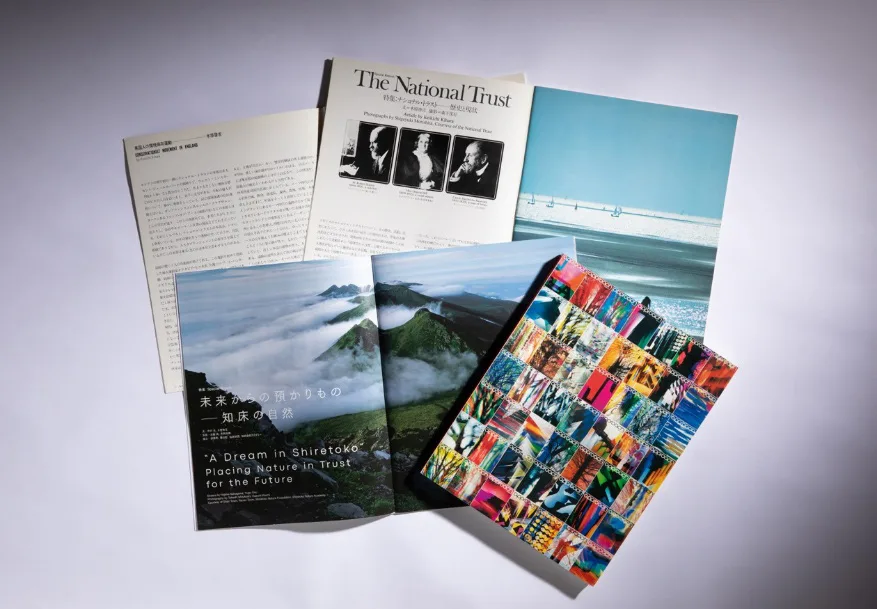
approach features, clockwise from top left: 1976 Winter issue introduced UK National Trust; the 1980 Summer issue expanded on this theme; approach 200th anniversary issue; 2025 Winter issue featured Shiretoko.
The Manufacturing Process as Art Form
In 1976, Nippon Electric Glass Co., Ltd. (NEG), a leading global manufacturer of special glass products, commissioned COSMO to provide editorial services for its corporate PR magazine P&P. COSMO worked with celebrated photographer Yasuhiro Ishimoto to conceptualize their advanced production processes: Ishimoto’s large-scale black and white photos depict molten glass and macro-imagery of electronic glass components as striking works of art. These attracted worldwide attention, and P&P magazine was awarded the International Galaxy Award 1996 Gold Prize, as well as the 2010 Japan Industrial Advertising Award, Special Prize in the PR Magazine Category.
Since its establishment in 1949, NEG has published an anniversary book each decade, with COSMO providing editorial services for the 40th, 50th, 60th and 70th commemorative publications. These showcase NEG company history alongside coverage of its advanced manufacturing technologies and special glass products.
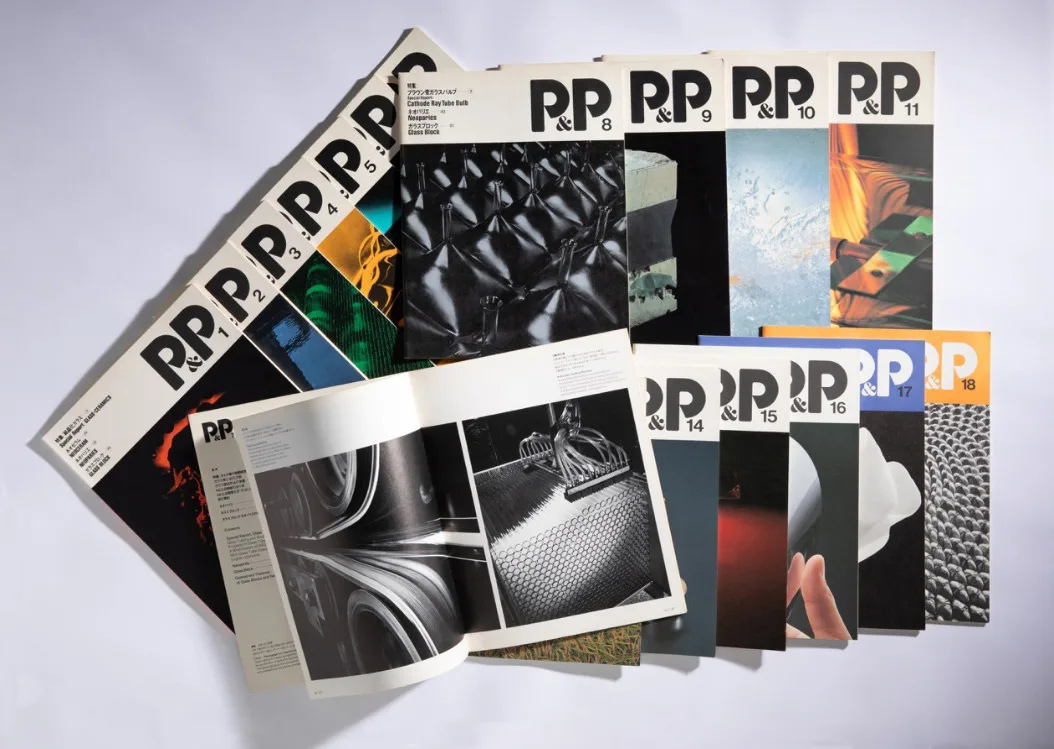
Nippon Electric Glass P&P magazine with photography by Yasuhiro Ishimoto
Conveying Company Philosophy With Japanese Culture
Our previous newsletter shared how COSMO’s corporate publications integrate Japanese culture with compelling imagery.
Early on, two books paved the way: The Rice Cycle: The Grain that Created a Culture, produced for the World Exposition in Spokane, Washington (1974); and The I Ro Ha of Japan, distributed at the International Design Conference in Aspen, Colorado (1979).
A third example is the Mazda Books series, developed by COSMO in the eighties and nineties for car company Toyo Kogyo Co. (now Mazda Motor Corporation). The first title in the series was The Wheel: A Japanese History (1981), which introduced wheel design through the lens of Japanese arts and crafts; this book concluded with images of the company’s newest sports car. The book was co-planned and edited by Professor Mitsukuni Yoshida5 of Kyoto University, Ikko Tanaka and Tsune Sesoko. The series eventually totaled nine books, the final being Wabi Sabi Suki—The Essence of Japanese Beauty6 (1993). The Mazda Books series won numerous awards for seven consecutive years, including annual Grand Prizes by the Economic Public Relations Center Foundation.7
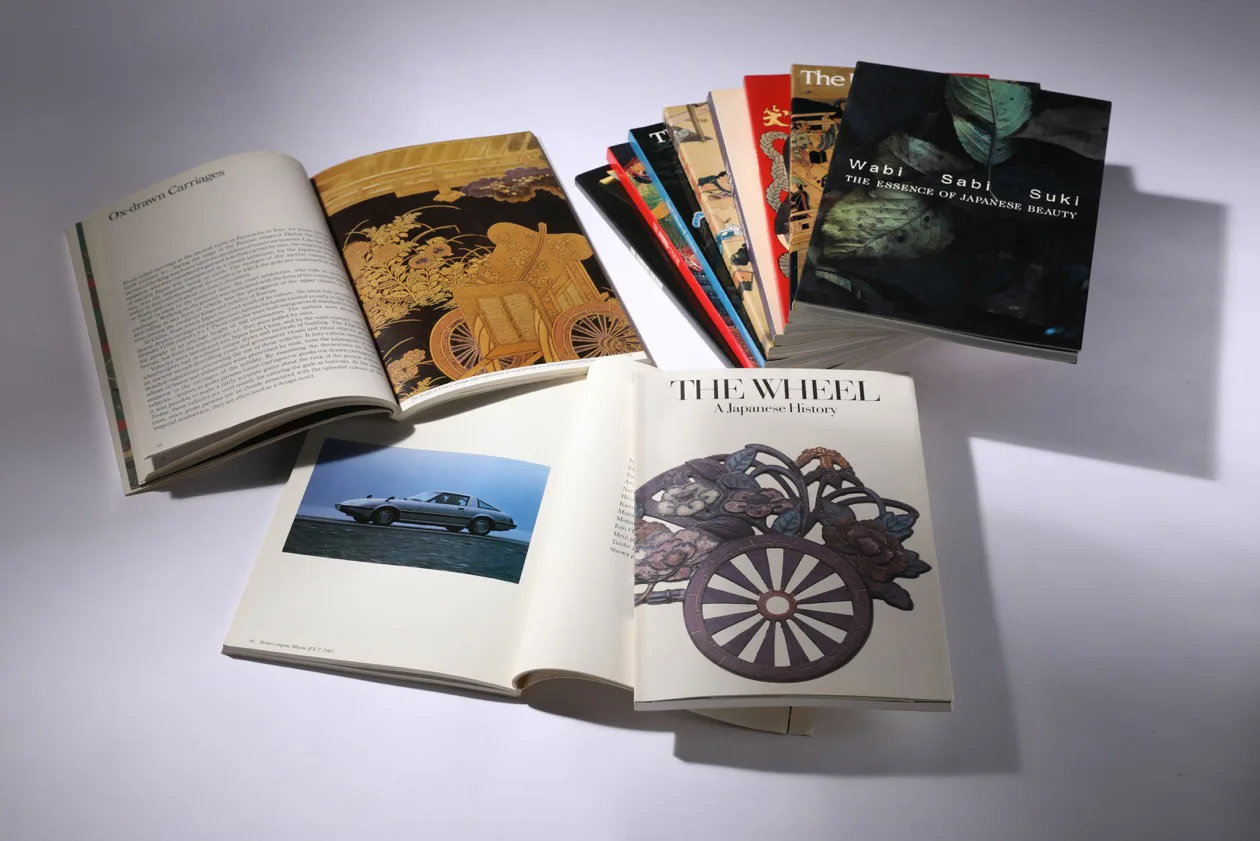
The award-winning Mazda Books series presented Japanese culture through engaging imagery.
Other culturally focused publications include The History of Lighting for Matsushita Electric Works, Ltd. (now Panasonic Corporation); Flowers and Wagashi—Traditional Japanese Confections for Toraya Confectionery Co., Ltd.; The Spirit of Japanese Food Culture for Kikkoman Corporation; and the Takenaka Carpentry Tools Museum anniversary book.
Through such projects, over the years COSMO has established a vast network of leading academics and creators who add depth, context and insight to both Japanese and English editorial services.
These and other projects underscore COSMO’s focus on client messaging complemented by the spirit of Japanese history and culture, supported by powerful editorial design.
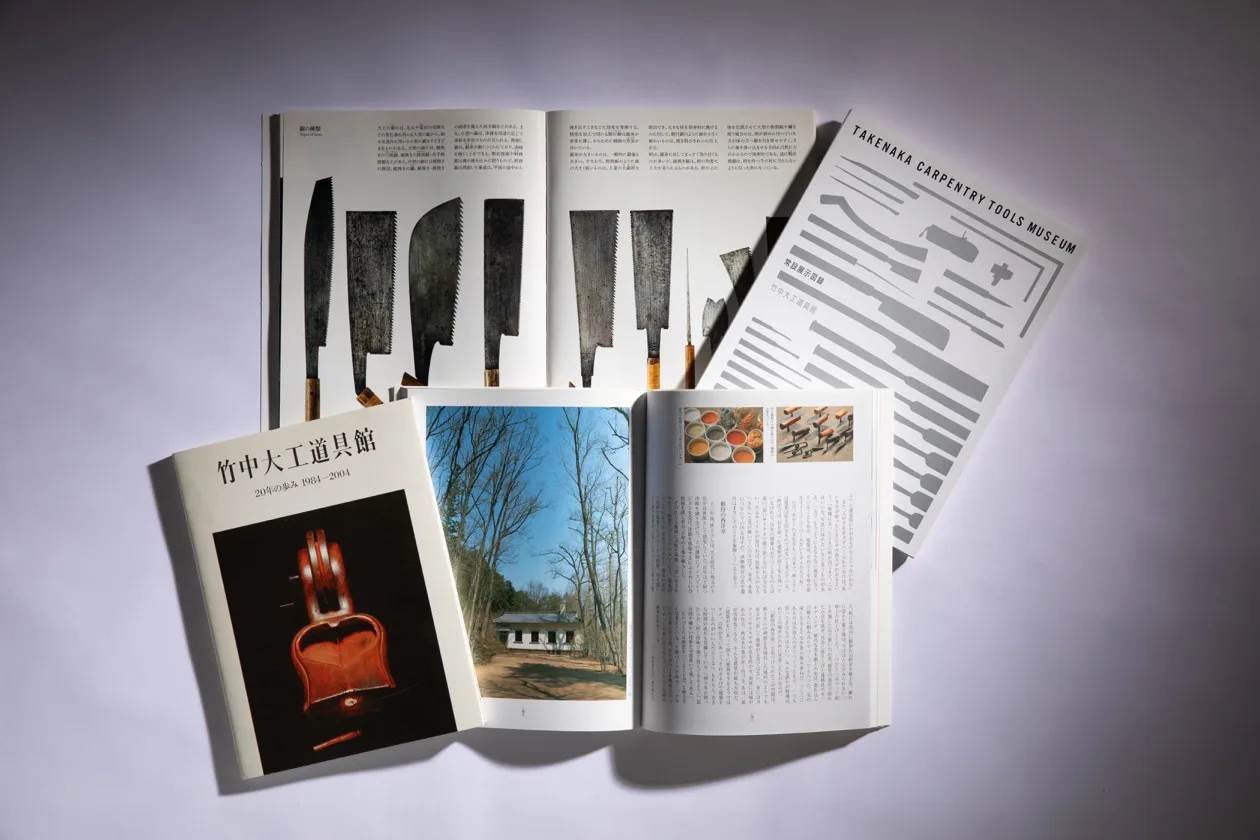
Publications for the Takenaka Carpentry Tools Museum
Unchanging Principles
These days, the internet and social media are crucial in conveying corporate information. COSMO offers not only traditional print-based services, but extensive digital media, website design and online corporate communications tools, spearheaded by innovative digital creators.
Corporate messaging tools may change, but COSMO recognizes that delivering consistent, focused and effective messaging remains the same—as does our Three Smiles Principle. We strive to achieve satisfaction among client, creator and reader, with the aim of contributing to society. Let us help you share your message.
■ Notes
1 The Three Smiles Principle. A business philosophy observed by Edo era (1603-1867) merchants which stressed that a business deal should be satisfactory to both buyer and seller and should also benefit society.
2 Ikko Tanaka (1930-2002). Graphic designer. Works include design of Tokyo Olympic medals, Saison Group corporate identity, launch of MUJI. Achieved international success with Rimpa-inspired compositions. Awarded the Medal with Purple Ribbon (1994) and named a Person of Cultural Merit (2000).
3 Yasuhiro Ishimoto (1921-2012). Second-generation Japanese American born San Francisco. Internationally acclaimed for architectural photography focused on modernism in traditional Japanese architecture. Awarded Medal with Purple Ribbon (1983); Order of the Rising Sun Gold Rays with Rosette (1993); and named a Person of Cultural Merit (1996).
4 Mécénat Award. Established 1991 by the Association for Corporate Support of the Arts to promote arts and culture for the betterment of society. Annual awards given to companies engaged in significant social contribution activities.
5 Mitsukuni Yoshida (1921-1991). Historian, history of science and technology in the East. Perceived industry and art as human technology. Professor emeritus, Kyoto University; director of the Institute for Research in Humanities, Kyoto University and Museum of Kyoto. Awarded Medal with Purple Ribbon (1987) Senior Fourth Rank; and the Order of Sacred Treasure (1991).
6 Text for this book was written by architectural historian Teiji Ito (1922-2010), following the passing of Prof. Yoshida in 1991.
7 English-language PR publications contest hosted by the Economic Public Relations Center Foundation from 1980-1989. The Grand Prize was the Keidanren Chairman’s Prize, given to companies who excelled in overseas public relations activities.